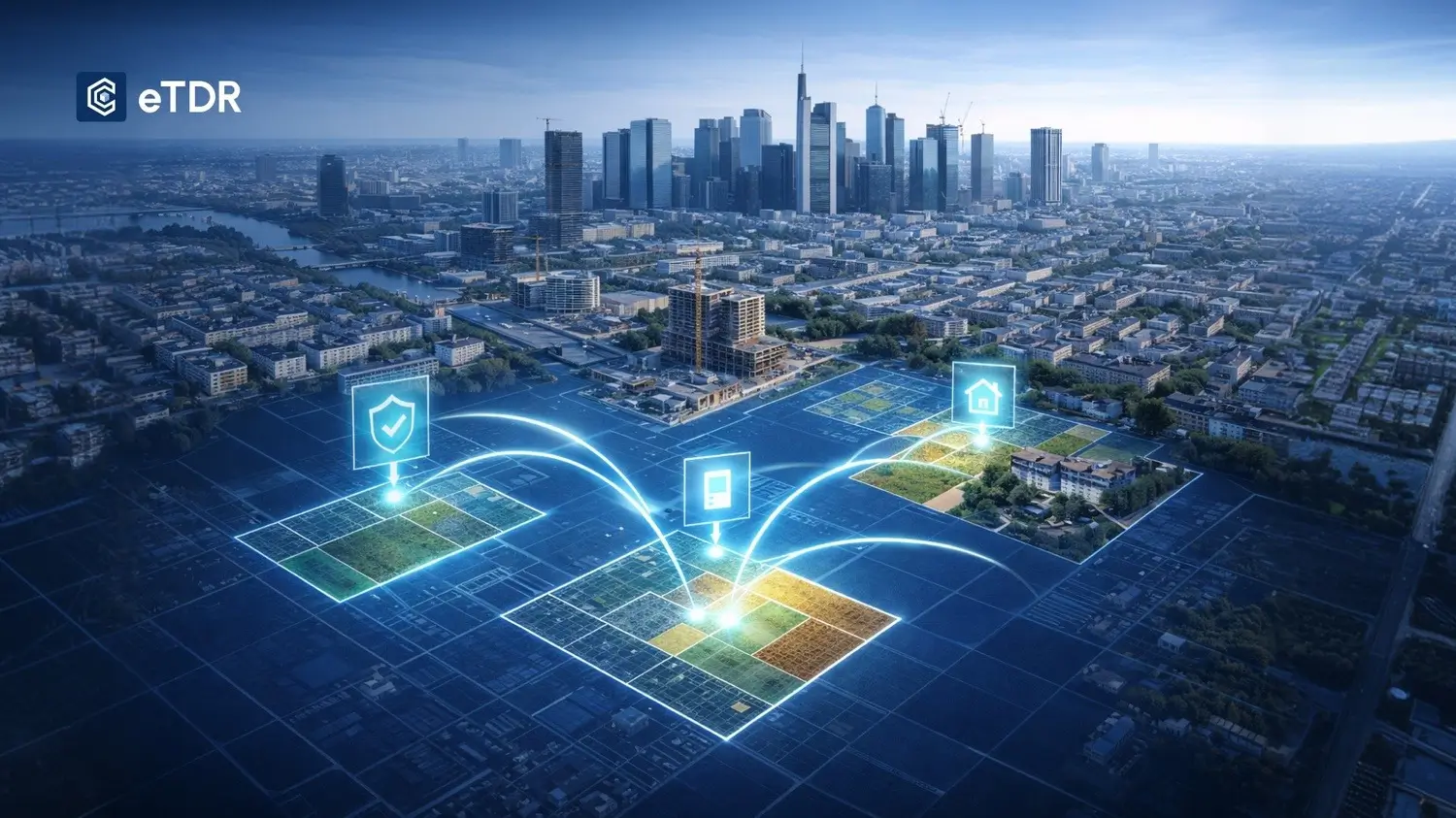
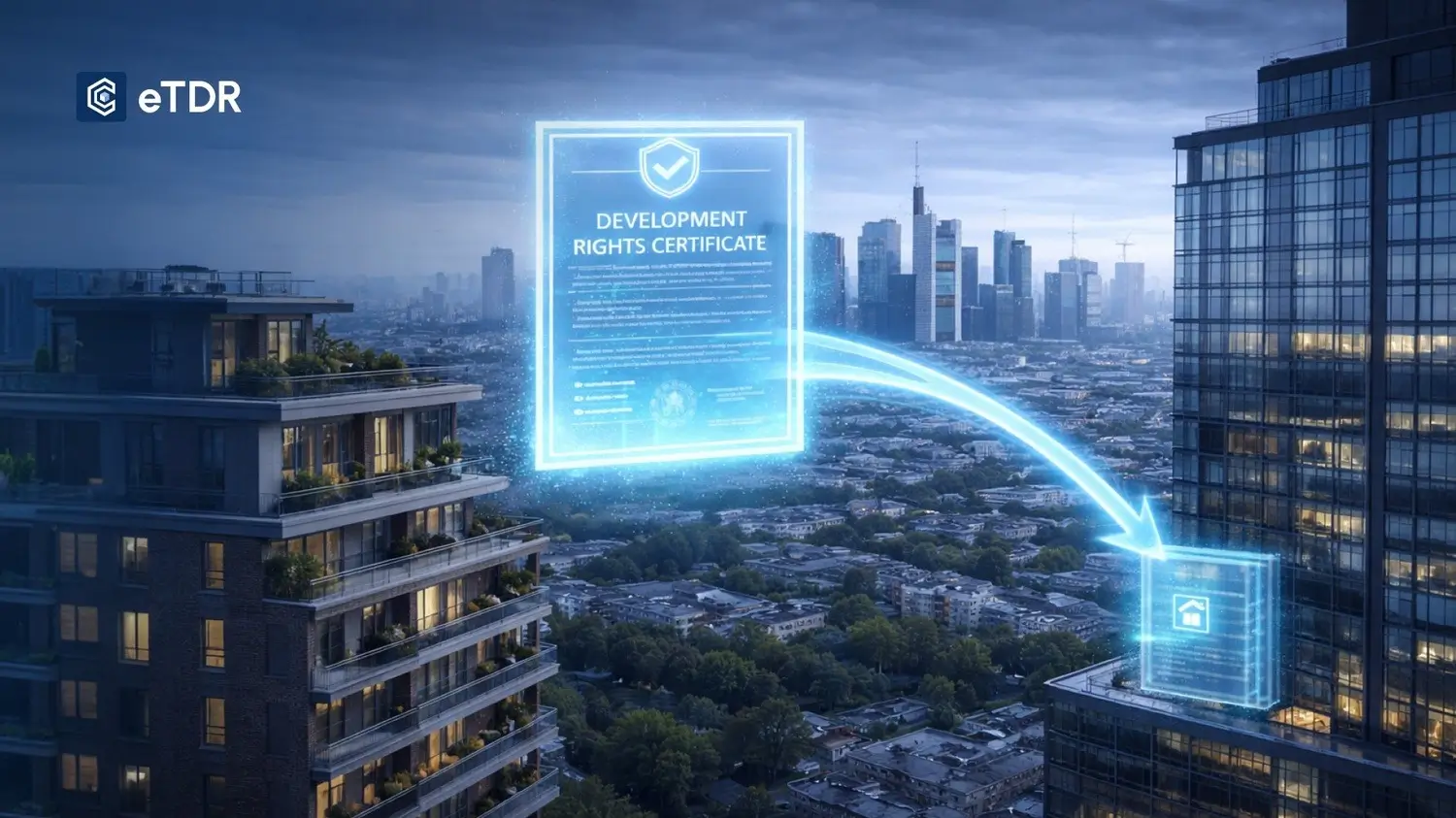
eTDR App & Platform: How the eTDR System Works in Practice

Most discussions about eTDR stop at the concept. They explain what it is, why it matters, and what
problems it solves — but leave a critical question unanswered: what does it actually look like when
you open the platform and start using it?

That is what this post covers. Not theory — the actual workflow. What a city official sees when issuing
a DRC. What a developer does when they need to buy one. What happens when a building approval requires
TDR verification. How the data surfaces in dashboards that give administrators a real-time view of the market.

Three People Who Use an eTDR Platform

Before walking through the platform, it helps to know who uses it — because each role has a completely different experience.

Platform Roles
Issuer
Typically a municipal or government authority. This is the person or body that creates a DRC when a landowner surrenders land for a public purpose — digitally issuing a verified Development Rights Certificate that is instantly live on the platform.
Seller
The DRC holder, usually a landowner. This is the person who received a DRC after surrendering land and wants to sell it to a developer. Their job is to list their DRC with an asking price and manage incoming offers.
Buyer
Typically a real estate developer. Someone who needs additional FSI for a project and wants to purchase Transferable Development Rights from a DRC holder — finding available DRCs that match their zone requirements, completing the purchase, and deploying the DRC in a building approval.

Every feature of the eTDR platform is built around these three workflows.

eTDR App: What Each Role Sees

When a government authority logs into the eTDR system, the first thing they see is their
issuance dashboard — a central view of all DRCs issued, pending, and active
within their jurisdiction. From here, issuing a new DRC takes a structured process:

  • 1

    Issuer: Enter the landowner’s verified identity, originating plot details, area surrendered, and DRC area being granted. Confirm and issue — the DRC exists digitally in minutes, no physical certificate, no manual registry entry.

  • 2

    Seller (DRC Holder): The received DRC appears in their account with full details. To sell, they create a listing — set an asking price, choose public or private listing, and track offers from interested developers. No broker involved.

  • 3

    Buyer (Developer): Opens the marketplace, filters by zone, area, and price, sees live market rates, initiates a purchase — ownership transfers, a verified transfer record is permanently created, and the DRC moves to their account instantly.


There is no broker involved for sellers. The DRC holder has complete visibility into who is interested and at what price — something structurally impossible in the paper-based TDR world, where pricing happened in back channels with no transparency.

eTDR Charts and Market Data: What the Dashboard Shows

One of the most underappreciated features of a well-built eTDR platform is the data layer —
the charts and analytics that give administrators and market participants a real-time view of what is happening.

Dashboard Analytics
Supply & Demand Charts
How much DRC area is currently listed for sale, broken down by zone. Which zones have excess supply, which are running short. This data is invisible in traditional TDR markets and is critical for city planners managing development density.
Price Trend Charts
Historical and current DRC pricing by zone. Developers can see whether prices are rising or falling before committing to a purchase. Municipalities can monitor whether DRC values reflect fair market conditions.
Transaction Volume
Number of DRC transfers completed per month, per quarter, per zone — giving city authorities a measurable view of TDR market activity that was simply not available when transactions happened informally.
Utilisation Tracking
How much of the issued DRC area has been utilised in building approvals versus how much remains active in the market — a direct indicator of development activity and FSI consumption across the city.

These are not vanity metrics. For a city administrator responsible for managing urban growth, this data is
operationally significant — it tells them in real time whether their TDR program is functioning as intended.

What Happens During a Building Approval

This is where the eTDR system creates its most tangible time saving. When a developer submits a building
application and declares TDR utilisation, the eTDR platform automatically:

  • Confirms the developer’s DRC balance in real time
  • Verifies that the originating zone of the DRC is eligible for the receiving zone of the project
  • Checks that the DRC has not already been fully or partially utilised elsewhere
  • Deducts the utilised area from the developer’s account
  • Issues a digital utilisation record that becomes part of the building file


A process that previously required a municipal officer to manually cross-check physical files — often taking days or weeks — is now completed in seconds. Entirely automated, entirely auditable.

How EveryCRED Delivers This for Your Organisation

EveryCRED’s eTDR platform is built for organisations that need this to work in the real world —
not as a pilot project, but as the operational backbone of a live TDR program.

The issuer dashboard, seller marketplace, buyer interface, analytics layer, and building approval
integration are all available on EveryCRED’s platform — configured for your specific regulatory
context, your zone structure, and your existing organisational workflows.

  • No need to overhaul your existing systems
  • No complex IT infrastructure to build from scratch
  • Configured for your regulatory context and zone structure

If managing TDR transactions is currently a manual, slow, or error-prone process for your team,
the platform is designed to fix that — without asking you to overhaul everything you already have.

What is eTDR?

If you work in urban planning, real estate development, or government infrastructure, you have almost
certainly dealt with Transferable Development Rights (TDR). And if you have, you know the frustrations
of paper certificates, opaque pricing, slow verification, and the ever-present risk of fraud.

eTDR is the answer to all of that. In this guide, we break down exactly what eTDR is, why it was
created, and how it works — in plain language, without the jargon.

eTDR Full Form: What Does eTDR Stand For?

The eTDR full form is Electronic Transferable Development Rights. Three words that tell the whole story:

Key Terms
Electronic
Everything happens digitally. No paper certificates, no physical handovers, no manual verification.
Transferable
The rights can be sold, transferred, or used by someone other than the original holder.
Development Rights
Legal entitlements that allow a holder to build additional floor space (FSI) beyond what their base plot permits.

Put it together: eTDR is a digital system that converts traditional paper-based development rights into
secure, verifiable, instantly transferable digital credentials.

First, What is TDR?

To understand eTDR, you need to understand TDR. When a government needs land for a public purpose —
a road, a park, a school, a drainage project — it sometimes cannot or does not pay the landowner in cash.
Instead, it issues a Development Rights Certificate (DRC).

A DRC is essentially a voucher. It says: “You surrendered X square metres of land. In return, you
are entitled to build X square metres of additional floor space somewhere else — or sell that right to
someone who needs it.”

The concept is sound. Governments fund public infrastructure without cash outflows. Landowners receive
real economic value. Developers who need extra FSI can buy DRCs from landowners who do not need them.
The problem is in the execution — specifically, in how TDR has been managed on paper.

The Problem With Paper-Based TDR

Here is what actually happens when TDR runs on paper and manual processes:

  • Fraud is rampant. Physical DRCs are documents. Documents can be forged, duplicated, and sold multiple times to different buyers. In markets where a single DRC can be worth crores, the incentive to commit fraud is significant.
  • Pricing is opaque. There is no central marketplace. Prices are negotiated privately through brokers, and the same DRC in the same zone can transact at wildly different values. Landowners consistently receive below-market rates.
  • Verification is painfully slow. When a developer wants to use TDR in a building approval, someone has to physically verify the DRC — check it against records, confirm it has not already been used. This takes weeks.
  • Small stakeholders get locked out. Individual flat owners, small landowners — the very people who most need access to the TDR market — cannot navigate the broker-dependent, bureaucracy-heavy process.

These are not edge cases. They are the everyday reality of paper-based TDR in most cities.

What eTDR Does Differently

eTDR solves each of these problems at the root:

  • 1

    Fraud-proof credentials. Instead of a paper certificate, a DRC is issued as a blockchain-backed digital credential — cryptographically unique, impossible to duplicate, and permanently traceable.

  • 2

    Transparent pricing. A live digital marketplace lists available DRCs with transparent pricing, so buyers know exactly what the market rate is before they enter a transaction.

  • 3

    Instant verification. Any authorised party can verify a DRC in seconds — one click confirms authenticity, ownership, utilisation status, and zone eligibility.

  • 4

    Accessible to all. Any registered participant — whether a large developer or an individual landowner — can transact directly through the platform, without intermediaries.

How eTDR Works: The Simple Version

The eTDR system manages three things:

The eTDR Process
1. Issuance
When a government authority issues a DRC, it creates a digital credential on the eTDR platform — cryptographically signed, assigned a unique identifier, and linked to the verified identity of the DRC holder. It cannot be forged or duplicated.
2. Transfer
When a DRC holder wants to sell their rights, they list them on the platform. A buyer searches, selects, and completes the transaction digitally. Ownership transfers instantly, with a permanent record on the blockchain. No broker. No paper. No delays.
3. Utilisation
When a developer wants to use a DRC for a building project, the eTDR system verifies their holding, confirms zone eligibility, deducts the utilised area, and issues a digital utilisation record automatically — in real time.


Building approvals that previously required weeks of manual cross-checking are now completed in real time. DRC issuance happens in minutes, not months. Fraud becomes mathematically impossible through blockchain anchoring.

Why eTDR Matters Right Now

Cities across India are modernising their urban development infrastructure. TDR programs that were
designed to be efficient policy tools have been undermined for years by the limitations of paper-based
systems. eTDR is not a distant future concept — it is a live, deployable solution that cities and
urban bodies can adopt today.

The benefits are concrete:

  • Fraud eliminated through blockchain-anchored credentials
  • Approvals faster with instant digital verification
  • Markets fairer with transparent, real-time pricing
  • Governance stronger with immutable audit trails

How EveryCRED Helps You Implement eTDR

Knowing what eTDR is and actually running one are two different things.

EveryCRED is an eTDR solution provider that handles the entire implementation — from setting up your
digital DRC issuance process to building the marketplace where buyers and sellers transact, to making
verification instant for your team.

  • No need to rebuild your existing systems.
  • No need for a new IT department.
  • You bring the mandate and the stakeholders — EveryCRED brings the platform.

Cities, urban bodies, and real estate organisations that have been stuck with slow approvals, fraud complaints,
and broker-dependent markets use EveryCRED to go fully digital — without the complexity that usually comes with it.

Want to see if eTDR is the right move for your organisation?

TDR Meaning: What Are Transferable Development Rights?

Cities grow. Roads get widened. Parks get built. Schools, drainage systems, and public amenities expand into land that is currently privately owned. And when that happens, governments face a fundamental question: how do you fairly compensate the landowner without draining the public treasury?

One of the most elegant answers urban planners have come up with is TDR — Transferable Development Rights. If you have encountered this term in a real estate transaction, a planning document, or a government notification and wondered what it actually means, this guide is for you.

TDR Full Form: What Does TDR Stand For?

The TDR full form is Transferable Development Rights. Breaking it down:

Key Terms
Transferable
The rights can be moved. They are not locked to a specific person or plot. They can be sold, assigned, or used elsewhere.
Development
These are rights related to construction and land use — specifically, the right to build a certain amount of floor space.
Rights
Legal entitlements issued by a government authority, backed by urban planning regulations.

Put together: TDR is a legal instrument that gives a landowner the right to build additional floor space — not necessarily on their own surrendered land, but on another eligible plot — or to sell that right to someone else who needs it.

Why Does TDR Exist? The Problem It Solves

To understand TDR, you need to understand the problem it was designed to solve. When a city needs to widen a road, it often needs to acquire strips of privately owned land that fall within the proposed road alignment. The traditional approach is direct cash compensation — the government pays the landowner the market value of the land and acquires it.

This works, but it has serious limitations. Land acquisition is slow, legally contentious, and expensive — especially in dense urban areas where land values are high. In a rapidly growing city with hundreds of infrastructure projects running simultaneously, the cash outlay required is simply not sustainable.

TDR offers an alternative: instead of paying cash, the government gives the landowner the right to build additional floor space elsewhere in the city — or to sell that right to a developer who needs it.

The landowner gets real economic value. The government avoids a large upfront cash payment. And the city gets the infrastructure it needs. When it works well, TDR is a win for all three parties.

Key Terms You Need to Know

Understanding TDR requires knowing four terms that appear in every TDR transaction:

TDR Glossary
Development Rights Certificate (DRC)
The actual instrument issued to the landowner. A DRC specifies the area of development rights the holder is entitled to — expressed in square metres of buildable floor space. It is the TDR in tangible form.
Sending Area
The plot from which development rights originate — the land that was surrendered for the public purpose. The DRC is generated from the sending area.
Receiving Area
The plot where the TDR will be used. Not all zones are designated receiving areas; urban planning regulations specify where TDR can and cannot be utilised.
Floor Space Index (FSI)
Also called Floor Area Ratio (FAR). TDR effectively increases the permissible FSI on a receiving plot — allowing more construction than the base regulations would otherwise permit.

How TDR Works: A Practical Example

Consider a simple scenario.

A landowner in Mumbai owns a plot along a road that the municipal corporation wants to widen. A 30 square metre strip of her land falls within the road widening alignment. She surrenders that strip to the city. In return, the municipal authority issues her a DRC for 30 square metres. This DRC is now her asset.

She has two choices:

  • A

    Use it herself. If she owns another plot in a designated TDR receiving zone, she can use the DRC to build 30 square metres of additional floor space on that plot — beyond what her base FSI permits.

  • B

    Sell it. She can sell the DRC to a developer who needs extra FSI for their project. The developer pays her a market price, receives the DRC, and uses it to unlock additional buildable area on their development site.

In practice, the majority of DRCs are sold because most landowners who surrender strips of road-widening land do not own large development plots in receiving zones. The DRC market is therefore an active secondary market, with buyers (developers) and sellers (DRC holders) transacting regularly.

Where Is TDR Used?

TDR is used globally as an urban planning instrument, but it is particularly significant in Indian cities — especially Mumbai, where it is embedded in the Development Control and Promotion Regulations (DCPR 2034) as a core mechanism for funding public infrastructure.

In Mumbai’s context, TDR is issued for:

  • Road widening — Landowners who surrender strips for road projects
  • Reservations — Plots reserved for public amenities (parks, schools, health centres) in the Development Plan
  • Heritage conservation — Owners of heritage-listed properties who are restricted from redeveloping
  • Slum Rehabilitation — Under Slum Rehabilitation Authority (SRA) schemes

Other Indian cities — Pune, Hyderabad, Bengaluru, and others — have adopted TDR frameworks of their own, each with varying rules on sending zones, receiving zones, and applicable FSI multipliers.

Limitations of Traditional TDR

The concept of TDR is sound. The implementation, however, has been deeply flawed in most cities — primarily because TDR has traditionally been managed on paper, through manual processes, and without any central marketplace.

The result:

  • Rampant fraud through forged or duplicate DRCs
  • Opaque pricing driven by brokers with information advantages
  • Slow manual verification that delays building approvals
  • A market effectively inaccessible to small landowners and individual stakeholders

These are not minor operational issues. They are structural failures that have consistently undermined the value TDR should deliver to the landowners, developers, and cities it was designed to serve.

TDR and eTDR: The Natural Next Step

Understanding TDR makes it immediately obvious why digitising it is not optional — it is essential. The paper-based limitations of TDR are not problems that better administration can solve. They are inherent to the medium: paper can be forged, manual processes are slow, and information asymmetry is inevitable without a central marketplace.

That is exactly what eTDR — Electronic Transferable Development Rights — addresses. By converting DRCs into blockchain-backed digital credentials, creating a transparent digital marketplace, and automating verification, eTDR transforms a well-intentioned policy tool into one that actually delivers on its promise.

With eTDR: DRC issuance happens in minutes, not months. Verification is instant via QR code. Trading is transparent with real-time pricing. Fraud becomes mathematically impossible through blockchain anchoring.

How EveryCRED Is Solving the TDR Problem

TDR was always a good idea. The paper-based system it runs on is not.

If your city, organisation, or real estate project is dealing with slow DRC verification, pricing disputes, fraud complaints, or approval backlogs — those are not process problems. They are symptoms of a system that was never built for the scale and transparency modern urban development demands.

EveryCRED works with cities and urban bodies to replace that broken system with a fully digital eTDR platform — where DRCs are issued digitally, transactions happen in real time, and verification that used to take weeks takes seconds.

  • No more chasing paper certificates.
  • No more depending on brokers for pricing.
  • No more building approvals stuck in manual queues.

If you are responsible for managing or participating in a TDR program and the current process is costing you time, money, or trust — EveryCRED is worth a conversation.